
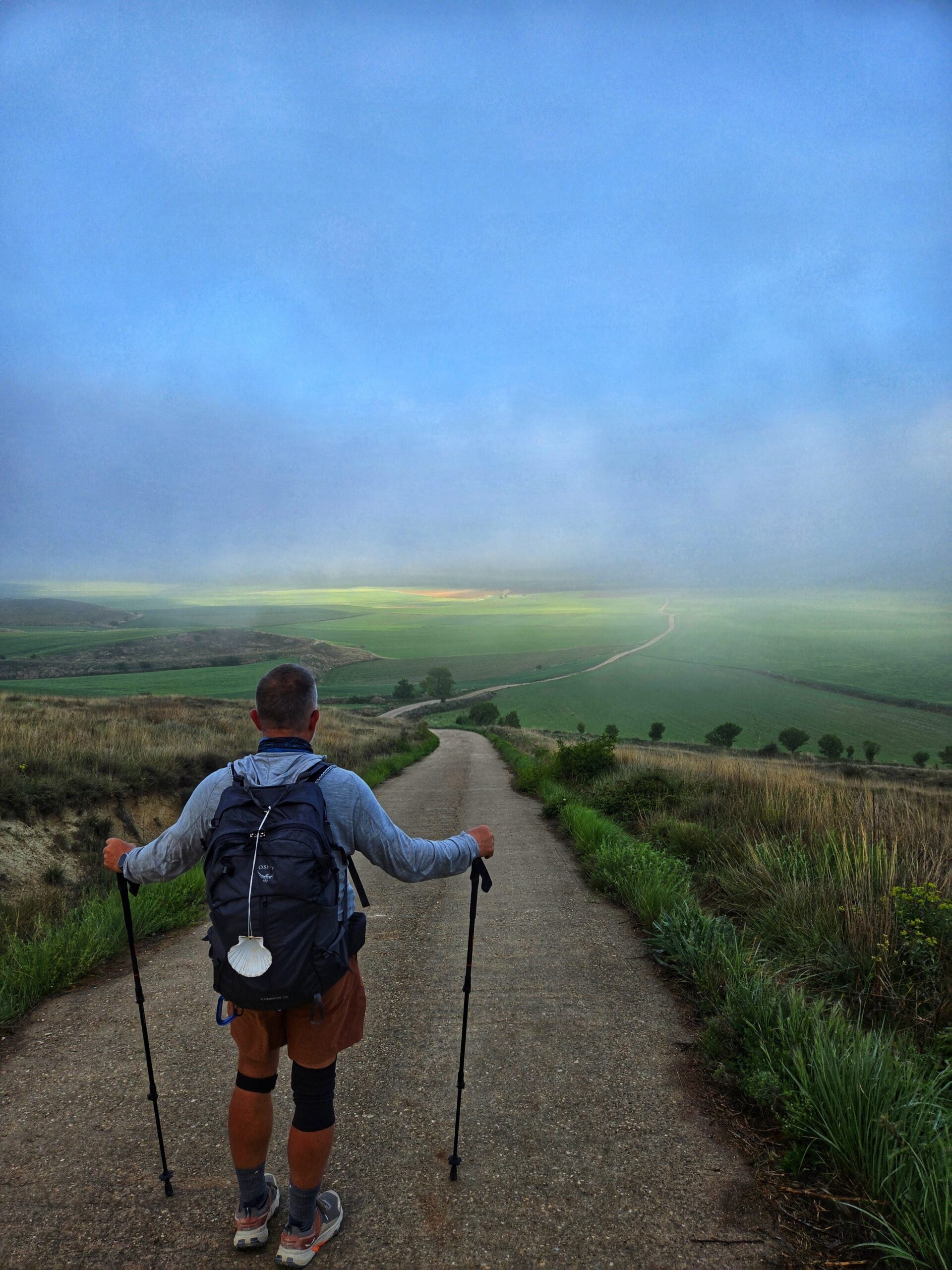
I packed my gear for this adventure with thoughtful consideration of what to bring and an open mind about what I might learn along the way. I really had no expectations for the outcome of this once in a lifetime trip. I was hoping to come back somewhat different from when I left home; otherwise, it’s just a long vacation with a lot of walking.
Friends have asked, “What’s your biggest takeaway from the Camino?” I have unpacked my gear since my return, but I haven’t fully unpacked the meaning of its importance. However, I can share some of the most pressing insights, all of which have surprised me.
My entire life, probably since around age 12, when I was still living in blissful ignorance of life’s demands, I have been forward-thinking. Always living in some future that doesn’t exist. I have to get good grades, so I can go to college. I have to go to college so I can get a good job. I need a good job so I can get married and have a family. I have to turn that job into a career. I need that career to help me retire. You get the idea.
The career, in fact, was almost 100% forward-looking. I had to help others plan for their future. Not only plan for the future, but also anticipate any outside influences that may sidetrack their plans. Like a sailor on the ever-changing sea, one eye on the vessel and another on the horizon. This pattern became my life and was both a blessing and a curse.
Within the first few days of the Camino, maybe even the first few hours, that pattern began to show signs of cracks and fissures. It eventually crumbled under the reality of having to literally watch every footfall while climbing over the Pyrenees. It became impossible to climb safely and still enjoy the scenery. One minute, you could be on a smooth path; the next, it is shrouded in fog, rocky or muddy, or dangerously close to the edge of a steep ravine, with the roar of the river hundreds of feet below.
This new pattern allowed me, for the first time in my life, to actually be in the present moment. Repeating this daily, I slowly made it a habit. Recognizing the pattern, I tried to feed this transformation by intentionally making no plans. Since I had places booked each night, I knew only my terminus for that day. I didn’t know where I would be staying until I hit the city limits, then figured out how to get there.
I walked in the morning by following the path and keeping my shadow in front of me. I stopped when I was hungry, and met strangers along the way, who would become my friends. Life unfolded effortlessly. In a word, it was beautiful. I stopped anticipating, which I think was key in supporting this transformation. I read enough of the guidebook to have a vague notion of the conditions I would encounter and the distance I would need to cover; the rest was simply free form. Brian, the free spirit. Which is laughable for anyone who knows me.
Living in the present moment was truly a gift to me, and one I will do my utmost to retain. But back in my home environment, where the demands on me go beyond just walking, it will be interesting to see if I am successful.
Another lesson I learned is that the status or stratification of people in any method is completely a human construct. On “the way,” everyone is equal. We are all pilgrims traveling in the same direction. How much you have in the bank account, or what degree you may or may not have, or your age, gender, or who you voted for, is immaterial. Everyone is the same, and we all have to do the work. I had a profoundly deep conversation with a young man who was 19 years old. Not once did I see him as anything but my peer. The only differences were the pace and the distance covered in each stage. Blisters, shin splints, and muscle cramps all hit equally.
Another notable point was that the linear community of camaraderie was extremely supportive of one another. This slowly transformed me and others to care for each other. I felt a pull towards kindness and openness, which caught me by surprise. I made it a point to stop or ask anyone who seemed to be in distress or at all uncomfortable if they needed anything. I traveled with extra lamb’s wool (blister care) and a small first-aid kit, just in case. There were only a few times when my help was needed, but I offered it because I saw it as the spirit of the Camino.
The favor was also extended to me on more than one occasion. For example, by living in the moment and not anticipating, I ran out of water in the 80-degree heat, with no services available for hours. Strangers offered me their water. I was touched by their generosity. People truly cared for one another in a way I had never seen among strangers before. In a word, I found this to be heavenly. Putting others first is a foreign concept in the “real world.”
In addition, locals living along this trail have historically helped pilgrims. Hospitals, hotels, churches, and restaurants have been supporting the pilgrim community for over a thousand years; it is part of their culture. The kindness extended to us by the locals became a topic of conversation. Approach a crosswalk in an urban area, and cars come to a screeching halt, with no apparent frustration or impatience. It was remarkable.
A common phrase along the way is, “Buen Camino.” It is a gesture among fellow pilgrims and other well-wishers, and it really means, have a good walk. I remember walking through the city streets of a small village between Zubiri and Pamplona, in the first week, when an elderly man with a cane wished me a “Buen Camino,” and it really touched me. This was still early on, and I was not accustomed to locals acknowledging my journey. It seemed like a friendly village, and it was close to noon, and I noticed the residents walking around with fresh baguettes. I followed them to the source and bought half a loaf of fresh-baked whole-grain bread for less than a Euro, which I ate while walking. Other times, young children on their way to school would wish us “Buen Camino.” Young and old, we were treated with love and compassion.
These are just a few of the takeaways I have identified, but as I continue to unpack, I will share others as they come to me.
I hope to honor the lessons I have learned by continuing to live in the moment and being kinder. We are just approaching tourist season in Leland, and I will have ample opportunity to make the visitors to this part of the world feel more welcome.