
My first encounter with artificial intelligence was during my formative years, when I logged hours upon hours of unsupervised time in front of the television. In my world, King Friday and Lady Elaine Fairchilde were every bit as real as Captain Kangaroo and Mr. Green Jeans. They became beloved friends and companions in my early years. I knew them, and I knew that I could trust them.
However, there were two very irregular characters in my television world which raised no shortage of suspicion in my young, pea brain. Both of which happened to be robots. Coincidence? I think not.
The robot on Lost in Space seemed to be… well, very robotic. He was not very agile; he didn’t have any human mannerisms, and he flailed his dryer vent arms around in a willy-nilly fashion (do people still say willy-nilly?) He seemed to be good for one thing and one thing only. He warned Will Robinson (Expertly portrayed by Billy Mumy) of any impending danger. He was like a slow-moving alarm clock for danger prevention that seemingly served no other function to the Robinson family.
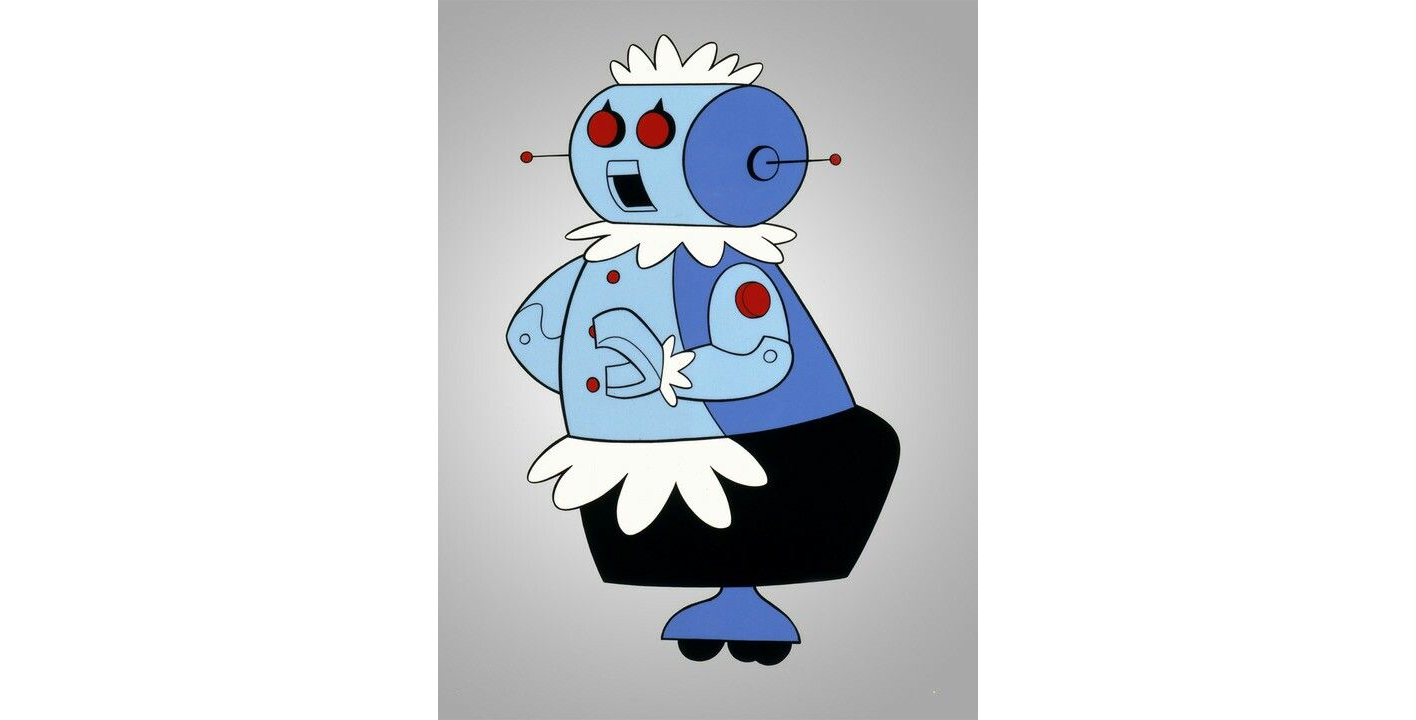
The other robot was much more humanlike in appearance and movement, and that was the very beloved Rosey the Robot from The Jetsons. Her official name included “the Robot” as if she might otherwise have been confused with other characters on the show. Rosey served the family in multiple ways, including fixing George his breakfast, looking after Astro, washing and cleaning the house, among other mundane duties. She even had a whisk broom and dustpan that popped out of her belly when a small mess needed attention.
I don’t ever recall a time when Rosey warned Elroy of any danger, which seemed the only task for the lost in space robot. In most ways, she was an active, beloved member of the Jetson home who served primarily practical functions.
Although these two characters brought suspicion to my young formative self, I thought that in some way these figures were an aspirational part of my life. Someday, I thought, way in the future, maybe we will have a robot who will do things for us. Even then, when I was still in single digit ages, I considered this notion with a fair amount of fascination and suspicion.
That suspicion came from the idea that they were not like the other characters in my world. And maybe in some way, I knew they were not in any way human, didn’t have a soul, and had no feelings. King Friday had feelings. Mr. Green Jeans had feelings. These were demonstrated weekly on the shows. I trusted them, in some small part, because they had emotions, just like me.
Fast forward to the present, and robots are much more real and active in our daily lives. Artificial intelligence has slowly been creeping into almost every aspect of our world. The same rumblings of suspicion I had as a six year old are still there. The only difference is now I have more wisdom, experience, and even more suspicion than ever before.
At first glance, most of these new additions to our world are benign and seem helpful. For example, my car has that thingy that helps keep me in my lane, reminds me to keep my hands on the wheel, and warns me if it looks like I am sleepy. How it knows is a mystery to me, but it is accurate 90% of the time. The autocorrect on this post will remind me when I misspell a word or forget a comma. These seem to be helpful little treats that make life easier.
One of the problems, however, is that AI is now moving into the endeavors which up until now, were reserved exclusively for humans. Those of us with emotions and souls. I recently learned (from two higher-ups in the tech world) that their beloved favorite music streaming service has recently begun creating content. This service will remain nameless; however, they have a recognizable green logo. The service has used the algorithms to learn what people like to listen to, musically, lyrically, and rhythmically, and has started to copy those sounds with new music (including vocals) in an effort to undercut the artists and not have to pay any royalties.
They are now creating content. This is not reserved for music, but the written word, articles, videos, images, and other areas which were heretofore entirely in the domain of humans. The infiltration has been so seamless that it is not even noticeable. That is, until you find you like a song they are playing and go to your streaming service to see who the artist is, only to find it is “original content.”
Just this morning, I saw an offer to have AI ghostwrite my next summer beach read novel. Where will it end? I may seem alarmist to you, but this insidious progress should be a clarion call to all humans of goodwill. What’s the big deal? You may ask. To me, the big deal is that once we are gradually relieved of functions that have long been uniquely human, we will devolve into the monosyllabic knuckle-draggers of our ancestors. We will have come full circle.
Once technology advances, our progress atrophies that skill set. We no longer memorize phone numbers because they are stored in our devices, we no longer use maps as we have GPS, we no longer listen to entire albums as we stream curated content, we no longer read long form articles or books because we have podcasts, we no longer actively have to think objectively or reason for ourselves because the narrative is always created for us, not only that, the narrative is also curated to match our already formed opinions.
All of the little conveniences rob us of skills we previously had, one of which is attention. The media, both social and otherwise, has dramatically reduced our attention span to that of a goldfish. Consider a movie from the 40s vs one from today. An entire scene back then could be shot from a single angle, with a single camera, for multiple minutes of dialogue. Today, each shot would last mere seconds before the perspective changes.
I assure you that I am not a luddite, as I wrote almost a year ago in “Original Content Written by a Flawed Human Being.” Perhaps, like Shakespeare wrote in Hamlet that, “I doth protest too much, methinks.” I will leave that for others to judge. Regardless, I find the relentless creep of artificial intelligence into our lives to be, in a word, creepy.
In the interest of your time (and interest), I have completely omitted the entire subject of the “thought” or “morality” of what is programmed into AI. This is where my biggest concern resides. The question is, who is teaching AI, and what values do they hold? That should give you the chills, as it does me.
Danger, Will Robinson, indeed.