
I have spent my entire life spelling my last name because the combination of four simple letters (two of which are the same) isn’t familiar to most people. I have gotten so many mispronunciations, including adding letters that don’t even exist in my name, such as Ursula. The most common mispronunciation, by far, is Uris. I have learned to just roll with it and not make it a big deal.
Recently, Joan and I retraced the steps of my father’s 1939 abrupt departure from Timisoara, Romania. So abrupt, we generally call it an escape. War was on the horizon, and my farming family somehow knew to make tracks from the vast uncertainty of the future of their homeland to the promised land of the United States of America. I have written about this before in A Journey to Go Back in Time.
I have providence and their forethought to thank for the life that I have been given in a country of relative freedom. Having spent close to three weeks in Eastern Europe I have learned so much of the brutal past they have endured learning of families belonging to as many as three different countries without ever moving from their home. Most of this part of the world has only been liberated since 1989. This is mind-blowing to me. I spent time with people and families who lived through this challenging time and some who were born after communism had been summarily dispatched.
I am not a sociologist, but I could not get enough of their stories and differing perspectives. Millennials have only known freedom, while their parents operated under severe restrictions and a palpable sense of paranoia in their own neighborhood. One driver told us about his father working in a butcher shop in the 80s and sneaking out a small piece of sausage (smaller than a hot dog), which led to his father’s subsequent arrest and a five-year prison sentence. These are real stories, from real people who lived under immense oppression at a time when my biggest struggle was which preppy outfit to wear to school.
When we arrived in Timisoara at our rented apartment, it was a Sunday evening about 15 minutes before Mass. We climbed the four floors of this old building, lugging our belongings, only to drop them off and try to find the church. By the time we hit the cobblestone street, the bells were pealing, making Google Maps irrelevant. We arrived just before the service began, and I marched right towards the front (as I am prone to do) and took our seats.
Of course, everything was in Romanian, and I had only begun learning the language 30 days before we arrived. Unless the priest opened with “I have two cows” or “good morning,” I was sunk. To me, the language barrier was not really a barrier. I followed the rhythm of the service and sang the songs in Romanian as best I could.
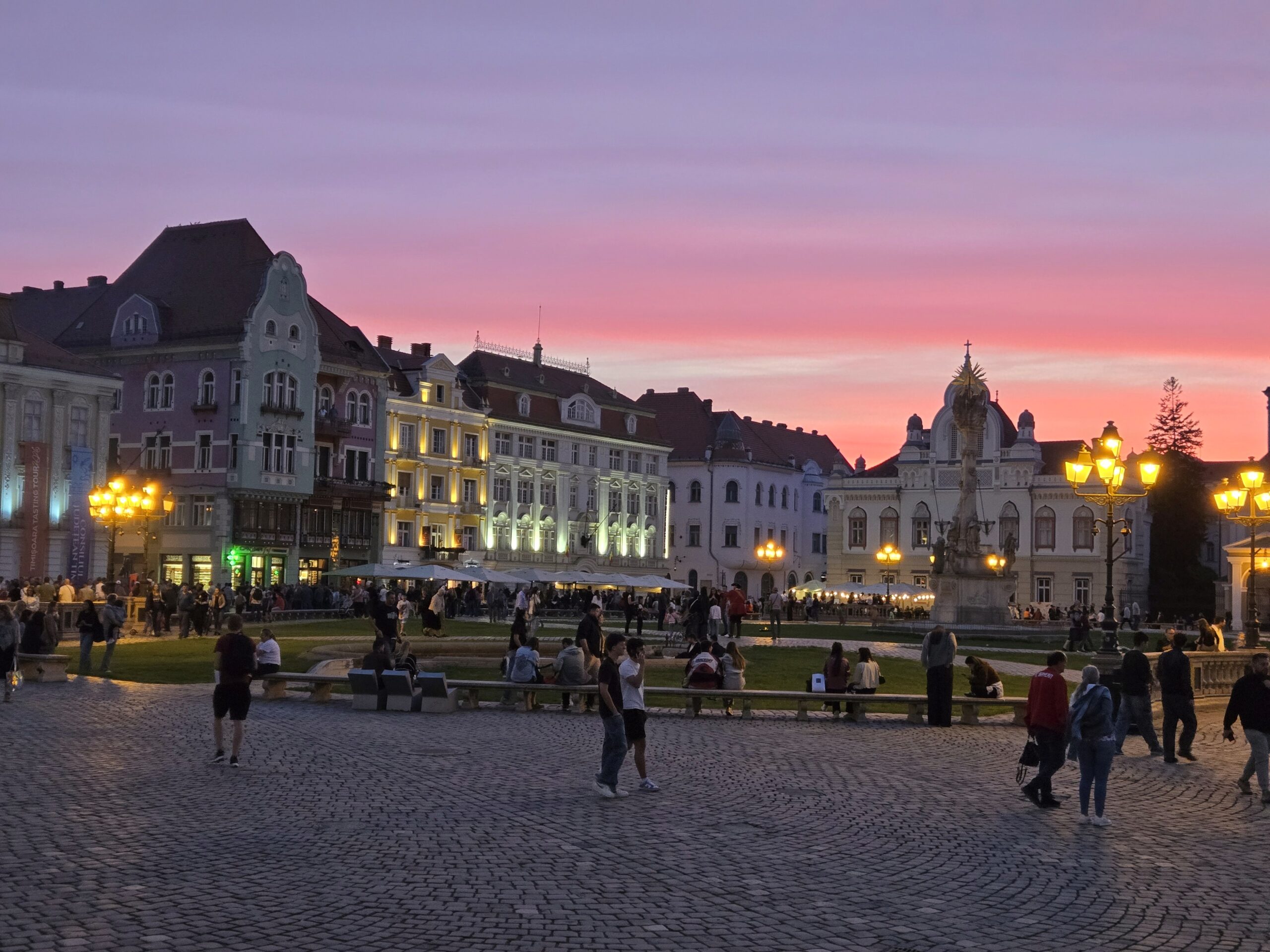
We were tired from traveling that day and frankly quite hungry. As we exited St George’s Cathedral, prominently situated on the east side of Union Square, the sun had just set, and an orange glow bathed these beautiful Austro-Hungarian buildings. This is when I snapped the photo for this post.
We didn’t have the luxury of time on arrival to take in this magnificent square, and I have to tell you, once we walked around the city, we decided it was the most beautiful city we visited on our trip. We later learned that because this city was off the beaten track and of little importance to the dictator Nicolae Ceaușescu, he left it largely intact. Unlike the brutalist Soviet architecture that dominated Bucharest, this city remained picturesque, making it Europe’s Capital of Culture in 2023.
Union Square is now paved with cobblestones, but in the 30’s it was the commercial hub for exchanging produce and other wares. I imagined my grandmother visiting this square, wearing her babushka and carrying her wicker basket, collecting the ingredients she needed to make their simple supper.
Speaking of my grandmother’s cooking, this trip allowed me to relive many of the meals and foods of my childhood. I felt her spirit every time a meal was set before me. If I closed my eyes, I would have been transported back 55 years to the family table, listening to the adults talk in Romanian.
At the end of the meal, when it was time to pay, my credit card revealed my name, and the server’s delight at recognizing it as Romanian never failed to make me proud. Their shock and surprise were evident; I felt like a celebrity. I was no longer just another American tourist on holiday; I was one of them, and they made me feel every bit of it. In a word, I felt like I was home.
Trying desperately not to disappoint them, I effused the Romanian vocabulary in as many opportunities as I had. Like the sprinkling of Holy Water on Easter, so liberal was my use of the few words I committed to memory. These words were accepted as intended, and I feel they appreciated the effort.
Over the next several days, we explored the city and the two other major squares fully, including what is known as Liberty Square, where the spark of freedom from communist oppression was ignited, resulting in the country’s full liberation only days later in the capital, Bucharest. This uprising and consequent freedom came at the cost of thousands of civilians’ lives.
We hired a local guide (and genealogist) who helped flesh out my family’s history for me, even taking us to the street where my father was raised. She even convinced a neighbor to let us into their home so I could see the conditions they would have lived in. I have no idea which house was theirs or whether it still stands, but the street is only 3 blocks long, and we marched up and down it. The whole thing was a little surreal and raised more questions than any of us had answers to.
This means that there will be another trip. A pilgrimage of sorts. And like Norm taking his familiar stool at the end of the bar in the TV show Cheers, I will be going back to the place where everyone knows my name.